




Industrialized construction no longer has a postcode.
For years, where you could build well depended on where you were. Not anymore.Wherever land is scarce, skilled labour is short and energy standards keep rising, the demand is the same and so is the answer. For developers, the question is no longer whether industrialized building works. It is whether their next project gets built with it or without it. One system. Repeatable. Ready where the demand is.


Execution doesn't start on site. It starts on the road.
In traditional construction, transportation is treated as a logistics detail. At Xpanel, we treat it as part of the engineering.
Because every panel we move is structure, insulation and resistance combined into one lightweight system. That means fewer materials to source, fewer shipments to coordinate and fewer trucks to deliver the same building.
Less volume on the road translates directly into lower fuel use and a smaller carbon footprint — before a single panel is even installed.
What looks like a detail in transport is, in reality, a design decision. The fewer journeys a building needs before it exists, the more efficient it already is.

Curved walls. Complex geometry. Built off-site.
Most people assume industrialized construction means simpler shapes and fewer design choices. The Espartinas Funeral Home proves the opposite.
Its distinctive curved architecture wasn't simplified to fit a faster system — it was made possible by one. Complex geometry, cleaner sites and greater precision came together in a building that challenges what people expect from industrialized methods, without giving up an ounce of architectural ambition.
Traditional construction was built for a century that's already gone. Xpanel is built for the one we're living in.
By integrating structure, insulation and resistance into a single industrialized system, Xpanel doesn't just speed up old processes — it replaces them entirely. The future of construction isn't about improving outdated methods. It's about redefining how buildings are designed, manufactured and built.

The panel is no longer a component. It's the strategy.
The panel is no longer a component. It's the decision the entire project is built on.
Not the façade. Not the finishes. The panel.
In construction, the system you choose at the start defines everything that follows: speed, quality, cost and long-term performance. At Xpanel, a project's success is decided long before the first occupant walks in.
A well-designed panel system accelerates timelines, cuts material use, lifts on-site productivity and reduces waste and rework — turning a fragmented process into a controlled, predictable operation.
And it shows where it matters most: on site. Where traditional construction means clutter and constant disruption, Xpanel brings order — cleaner, safer, more sequenced sites where every element has a purpose.
Less waste. Less disorder. Less rework.
Because when the panel is right, everything built on top of it is stronger.


Owning a home has become impossible.
Owning a home has become increasingly out of reach for an entire generation. But this isn't just a housing market problem it's also a construction problem. For decades, the industry has relied on methods that are slow, labor-intensive, and increasingly expensive. Every additional month on site adds cost, every delay pushes affordable housing further away, and a shrinking skilled workforce continues to make the challenge even greater. The uncomfortable question is: can we solve a 21st-century housing crisis with a 20th-century way of building?
At Xpanel, we don't believe we can. That's why our technology was designed to build faster, more efficiently, and at industrial scale, reducing construction timelines and costs without compromising quality or performance. Affordable housing shouldn't be an aspiration reserved for the few it should be an achievable reality for millions. The world needs more homes, delivered faster, smarter, and more sustainably. And the world can't afford to wait any longer.

From Pilot Project to Stadium-Wide Transformation
What began as a pilot project has evolved into something far greater: a clear demonstration of how innovation can reshape the future of construction.
At the Murcia FC Stadium (New Condomina), our Spanish partners K8 Installers successfully delivered the new stands using Xpanel Building Technologies, completing the work in approximately half the originally planned timeframe. More than just a construction milestone, this project became a real-world proof of what can be achieved when advanced building systems, skilled execution, and a shared vision come together. Speed was only part of the story. The project showcased the efficiency, precision, and adaptability of the Xpanel system, allowing the team to accelerate delivery without compromising quality, safety, or performance. In an industry where time, cost, and productivity are critical factors, these results demonstrated a new way forward.
The impact was immediate. Following the success of the pilot phase, the stadium owner has now taken the decision to move forward with the transformation of the entire stadium using Xpanel technology. A powerful example of how a single successful implementation can build confidence, create momentum, and unlock opportunities on a much larger scale.
Projects like this remind us that innovation doesn't need to start with massive change. Sometimes, it starts with one section, one structure, one challenge — and the results speak for themselves. This is more than a stadium renovation.
It's a glimpse of how the future of construction is being built today.


While temperatures rise, construction adapts.
Construction doesn't always happen under the sun.
In many parts of the world, especially during the hottest months, temperatures can make daytime work more challenging. That's why construction activity often continues into the evening and night, allowing teams to work in more comfortable conditions while keeping projects moving forward.
At Xpanel, our system is designed to deliver speed and efficiency regardless of the time of day. Whether under daylight or site lighting, every panel installed brings projects one step closer to completion.
Because building smarter also means adapting to the environment and finding the best conditions to keep progress on track.
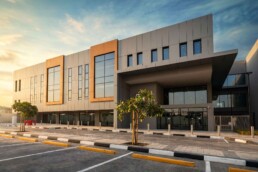
Built beyond scale.
Great structures are not defined by their size alone.
They are defined by the engineering behind them, the efficiency of their construction, and their ability to stand the test of time.
At Xpanel, we continue to prove that advanced construction systems are capable of delivering projects at every scale. From residential developments to large commercial, industrial and mixed-use structures, our technology is designed to provide strength, speed, precision and durability without compromise.
Every large scale project represents a challenge. Higher demands, tighter deadlines and greater expectations. That's where innovation makes the difference.
Because the future of construction isn't just about building bigger.
It's about building smarter.

What if luxury could be built faster?
The future of housing is no longer a concept. It is already taking shape.
At Xpanel, our modular homes for DAMAC Properties are redefining how high-quality residential developments can be delivered. Combining speed, precision, durability and sustainability, these homes showcase what is possible when innovative construction systems replace traditional limitations.
Built with efficiency at their core, every module is designed to reduce waste, optimise resources and accelerate delivery, while maintaining the architectural quality and premium standards expected from world-class developments.
This is more than modular construction.
This is a new way of thinking about how homes are created, delivered and experienced.
The future isn't being planned. It's being built.


Somewhere right now, someone’s dream home is already taking shape.
Somewhere right now, someone’s dream home is already taking shape.
Maybe it is hidden between the mountains. Maybe overlooking the ocean. Maybe in the middle of a growing city where a family is imagining their future for the very first time.
What is fascinating about construction is that while most people only see the final result, the real story happens long before that. It happens in factories, on-site, in design decisions, in engineering calculations, and in the hands of the teams building something that once existed only in someone’s imagination.
At Xpanel, we believe a home should be more than walls and concrete. It should be stronger, smarter, more sustainable, and built to last for generations. That is why we continue developing systems that allow projects to be delivered faster, with greater precision, higher energy efficiency, and lower environmental impact.
Because the house of your dreams is no longer a distant idea.
It could already be under construction.